


Before the Turbines Turn: Inside the Flora and Fauna Recovery Effort at Los Cañones Wind
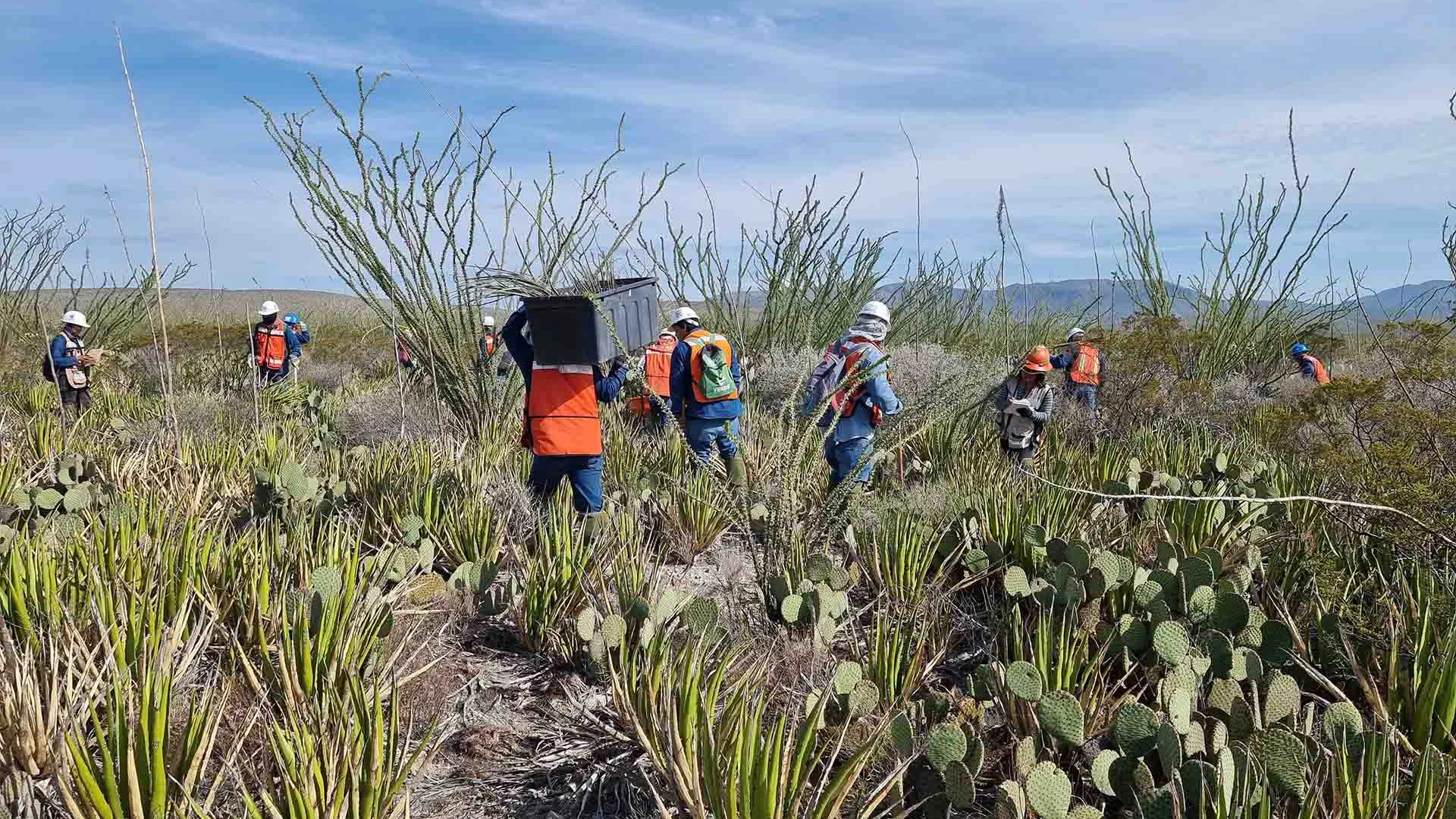
Long before the blades of the Los Cañones Wind began spinning, a different kind of crew was already on site. These were not engineers or construction teams, but biologists, botanists and graduate students working together to protect native species of the Chihuahuan desert.
Located in northern Mexico in the state of Coahuila, EDP Renewables North America’s (EDPR NA) Los Cañones Wind is a 96 MW project with 20 wind turbines powering Mexico’s national energy grid. Developing this site required a carefully coordinated plan to protect the desert ecosystem before any construction could begin – with oversight by EDPR NA’s Environmental Affairs team every step of the way.
A Landscape Worth Protecting
The state of Coahuila sits within the Chihuahuan Desert, which stretches across northern Mexico before crossing into the U.S. Southwest. This is desert scrubland where agave, cacti, and hardy shrubs adapt to an arduous climate, along with various species of birds, reptiles, and mammals.
Daniel Román-Salazar, a member of EDPR NA’s Environmental Affairs team in Mexico since 2021, has been closely involved in projects like this one, navigating them through Mexico’s permitting process. The country’s environmental regulation is governed federally, so it’s highly consistent across the country, in contrast to the state-by-state permitting matrices for in the U.S.
Before construction could begin, EDPR NA commissioned baseline biodiversity surveys of plant life and wildlife – both terrestrial and volant – which were performed by teaching staff and graduate students from the Universidad Autónoma de Nuevo León (UANL). Those surveys informed the environmental impact assessment EDPR NA submitted to SEMARNAT, Mexico's environmental authority, which ultimately issued a permit with binding conditions. Chief among them: survivability thresholds for any rescued flora and fauna.
The work at Los Cañones reflects EDPR NA’s broader environmental strategy, which can best be expressed through the mitigation hierarchy: avoid, minimize, restore, and compensate for remaining impacts. These were the project guideposts through three coordinated goals: rescuing and relocating native plants, safely relocating wildlife, and reforesting the land once construction was over.
Rescuing a Desert, Plant by Plant
During construction, a dedicated crew of UANL Biologists – led by Drs. Antonio Guzmán Velasco and José Ignacio González Rojas – worked in lockstep with the construction team, identifying and extracting plants before ground was disturbed. They paid close attention to slow-growing species like cacti that can take decades to reach maturity, and to species listed under NOM-059-SEMARNAT-2010, Mexico's federal list of protected species.
“Once the plants were collected, we carefully transferred them to another site with the same or very similar environmental conditions,” Salazar explains, “The same type of soil, topography, and a similar density of surrounding vegetation.”
Latest figures put relocated flora survival at 88.3%, comfortably above the 80% threshold required for compliance. Salazar credits success to continued care from UANL's team.
“During periods of severe drought, they provide ongoing irrigation and weeding to tend to the transplanted populations,” he notes.
By the end of construction, the program had rescued and processed 17,195 individual plants across 37 species. Fourteen of those species – nearly 38% – carry federal protection status, including desert natives like peyote, the goat's horn cactus, and the creeping dwarf yucca. Cacti made up a large majority of what was rescued, alongside yuccas that Salazar describes as similar to the Joshua tree.
Moving Wildlife to Safety
Along with the plants, the team focused on animals, particularly slower-moving or ground-dwelling species such as tortoises, kangaroo rats, snakes and lizards, which wouldn’t be able to easily avert construction activity on their own. More mobile species like coyotes and foxes were also part of the effort, though they could move away from activity more readily. Field teams didn't just clear an area once; they continued on site with active work fronts to catch animals that returned, stayed hidden in vegetation, or had burrowed underground during earlier surveys.
Animals were relocated four to five miles from the site, to habitat with similar environmental conditions. To the extent possible, they were only moved during non-breeding periods to reduce stress on the animals.
In total, the program relocated 590 wildlife individuals across 32 species, including 22 different kinds of reptiles and 10 mammals, with 13 species carrying federal protection status. The result: 100% survival during handling and relocation.
Growing the Desert Back
The final piece of the program is longer-term: reforesting more than 270 acres of land using species selected not just for their presence on site, but for their ecological role as food sources, nesting habitat, soil stabilizers, or "nurse plants" that shelter young cacti as they establish.
UANL has already collected and banked 6,850 seeds as germplasm, with 3,985 plants currently conditioning in nursery beds and another 9,562 growing in greenhouse conditions. Most are expected to be ready for planting once Mexico's 2026 rainy season arrives.
More Than a Permit
For Salazar, the work goes beyond checking a regulatory box. The programs have created local opportunities for greenhouse and nursery operations, providing germination, watering, and plant care. -EDPR has run community workshops introducing nearby residents to the native species living around them.
EDPR NA exercises the same due diligence throughout its projects with careful attention to local regulations, from the desert habitat in Coahuila to the grasslands in Calgary. But as Salazar points out, few places demand — or reward — this level of rigor quite like Mexico. Fortunately, the survival numbers speak for themselves.


