


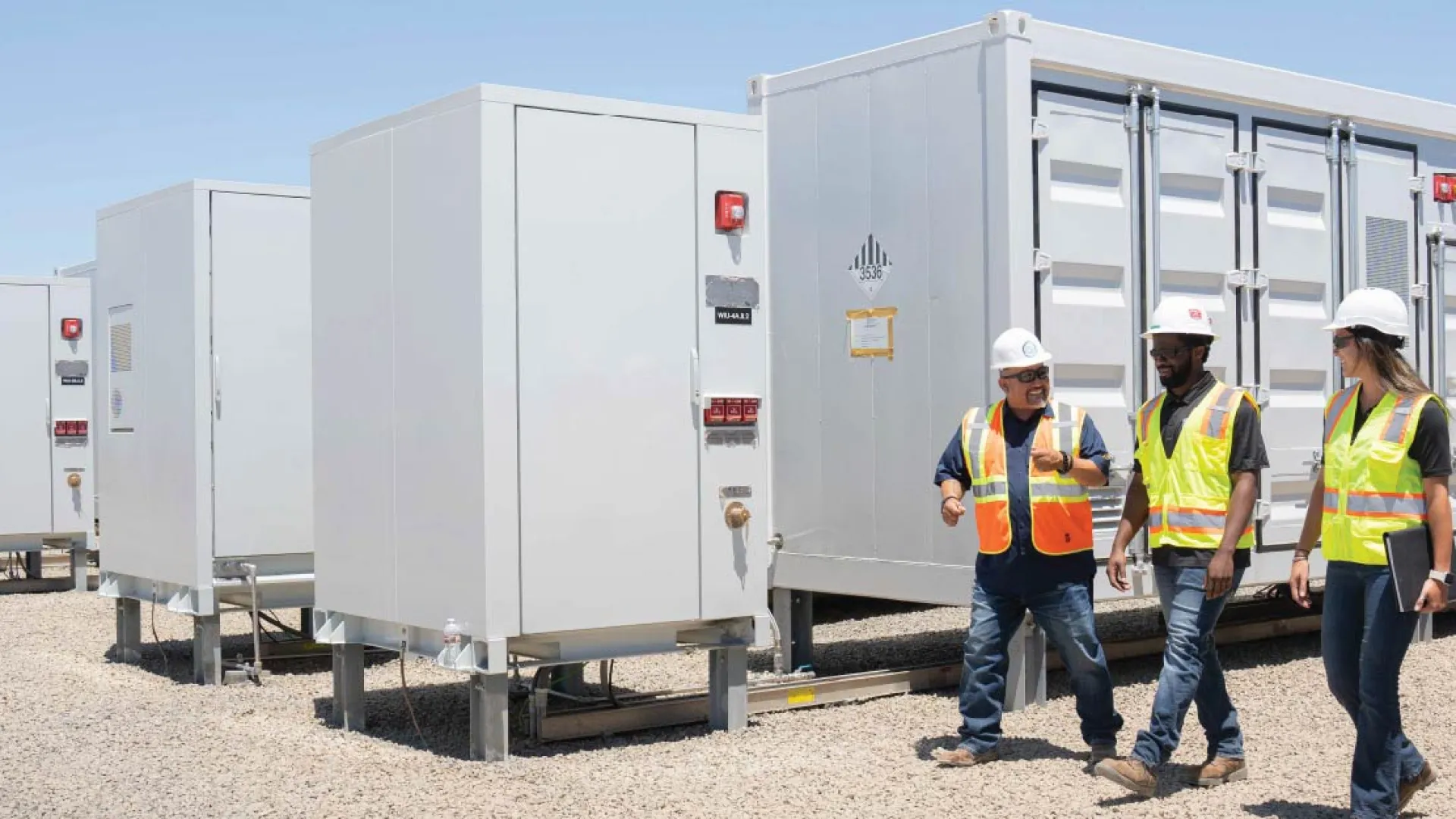
Building Safety into Every Phase of Renewable Energy Project Development
At EDP Renewables North America (EDPR NA), safety planning, training and oversight are integral to every stage of the clean energy development process. Keeping people safe before, during, and after construction of a renewable energy project is a commitment that begins long before the first shovel breaks ground – and continues every day.
"A lot of companies out there say the words, ‘safety first.’ We hear that all the time,” explains Scott Anderson, Senior Associate of Safety & Security. “But at EDPR NA we don’t just talk about safety – it’s part of everything we do.”
A strong safety foundation protects communities and workers and ensures that every site produces electricity securely and efficiently.
Safety Starts Before Construction Begins
Safety begins at the pre-construction phase—through planning, coordination, and clearly established channels of communication.
Before a project breaks ground, EDPR NA safety coordinators manage a thorough process to ensure safety is built into every part of the project. For example, the safety team evaluates potential vendors for their safety records and incident rates, and reviews site-specific safety plans. Pre-construction plans must include proper emergency response locations, dedicated safety personnel ratios, and a schedule of regular audits to ensure continuous improvement and open communication.
Once contractors are selected, safety meetings with contractors and partners are held to ensure all parties are aligned on key pre-construction safety protocols:
- Development of unified safety strategies
- Establishment of communication practices
- Identification of potential risk scenarios
Each project site is also assigned an overall Safety Consultant, a vetted third party stationed at utility-scale projects from project initiation through commissioning.
Safety During Construction
Having protocols on paper is one thing—but the key to safety planning is making sure protocols can be mobilized quickly and effectively when needed. During the construction of a wind or solar project, any number of situations can arise, from severe weather to on-site accidents or security incidents. Rather than waiting to react when something happens, comprehensive safety programs include detailed scenario planning and training so that dedicated staff know how to respond in real-time to emerging situations.
In addition to this site-wide preparation, EDPR NA safety coordinators are tasked with the following responsibilities in the event of a safety incident:
- Investigating immediately to understand what happened
- Conducting root cause analysis to identify underlying factors
- Assessing whether additional protocols are necessary beyond the immediate response
- Coordinating with all relevant parties to implement solutions
Safety During Operation
Once sites are commissioned and operational, the focus on safety continues. Site staff regularly participate in ongoing drills and scenario planning – from earthquake preparedness in seismic zones to tornado or hurricane drills in areas prone to those weather patterns.
EDPR NA’s Health & Safety Department also conducts trainings with local emergency service workers to familiarize them with project sites in controlled settings. Project safety coordinators work with first responders to establish and update an Emergency Response Plan and facilitate both written information and on-site drills for every project. Drills practice a variety of scenarios such as:
- Thermal Events
- Security Events
- Severe Weather
- Medical Emergencies
This level of preparation ensures that when emergencies occur, teams don’t waste precious time figuring out what to do. The protocols are already in place, tested, and understood by everyone involved.
To keep teams even more on their toes, Senior Associate of Safety & Security Jeff Bononcini, who oversees safety in field operations, takes an innovative approach. He pins notes with different scenarios onto dummies and places them at various locations around a project. A site staff member who encounters the dummy must then determine the best course of action for whatever “condition” the model is facing – from a slip and fall to an electrical shock. Jeff and his team of area safety coordinators, positioned throughout North America, conduct these drills and evaluate responses in real time to ensure ongoing learning for all team members.
If any concerns are raised, project management teams err on the side of caution—always prioritizing safety over schedule or cost considerations.
Safety Isn’t Proprietary
Perhaps the most fundamental part of the safety philosophy at EDPR NA: Safety is not proprietary.
Safety information is shared among everyone involved in a project to make sure injuries are avoided at all costs.
“If a practice can save a life, we want to make sure that it's shared with all parties,” Scott emphasizes.
Safety isn’t a box to check in renewable energy development—it’s the backbone of every successful project. At EDPR North America, that commitment begins well before construction and continues throughout a project’s lifespan, shaping how teams plan, train, communicate, and respond.
By embedding safety into every phase, partnering closely with contractors and first responders, and continuously refining protocols through real-world drills and scenario-based learning, EDPR NA ensures that workers, communities, and project assets remain protected. Openly sharing safety practices reinforces a simple but powerful belief: when it comes to protecting lives and preventing injuries, collaboration matters. Safety is—and always will be—fundamental.
Authors
Jeff Bononcini
Health & Safety Senior Associate
jeffrey.bononcini@edp.com
Scott Anderson
Health & Safety Senior Associate
scott.anderson@edp.com


